Walk into almost any small factory in India today — garments in Surat, auto parts in Ludhiana, packaging in Ahmedabad — and you'll likely find the same inventory system: a physical register, a Google Sheet, or at best, an Excel file updated by one person.
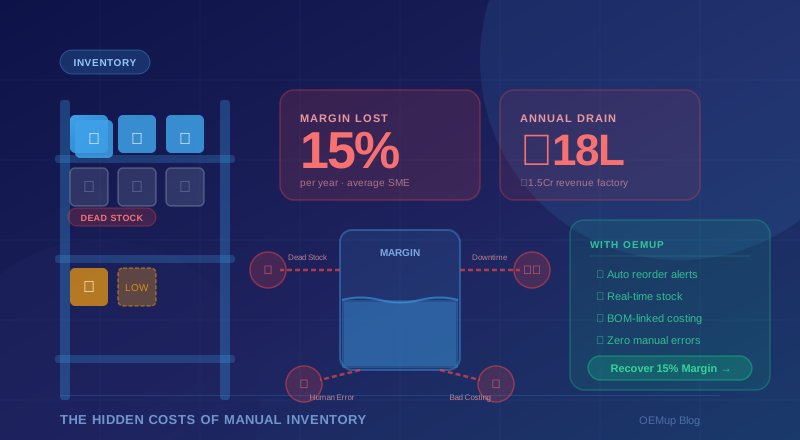
It works, in a sense. Orders get fulfilled (mostly). Stock gets replenished (sometimes late). But what if we told you this system has a leak — a quiet, ongoing drain that costs you 10–15% of your gross margin every single year?
This isn't a rough estimate. It's a composite of what we've seen across hundreds of factory owners who switched to OEMup Manufacturing ERP. The losses aren't from one big mistake. They're from four small leaks that happen every day, invisibly.
Leak #1: Dead Stock — Paying for Items Nobody Will Use
When reordering is done by "feel" — when someone walks past an empty shelf and thinks "we're running low" — you almost always order too much of some things and too little of others.
Dead stock is raw material or finished goods sitting in your warehouse with no demand. It occupies space, ties up working capital, and slowly becomes unsaleable — especially for components with shelf lives, or fast-fashion garments where styles change quarterly.
A factory with ₹50 lakh in inventory typically has 12–18% sitting as dead or slow-moving stock. That's ₹6–9 lakh in locked capital earning you nothing — plus 18% GST you've already paid on it, which you cannot reclaim.
With manual tracking, you have no way to calculate stock ageing. You don't know which items haven't moved in 90 days, and by the time you notice, it's too late.
What OEMup does differently
OEMup's Inventory module automatically flags slow-moving stock with configurable ageing thresholds (30/60/90 days). You see a live dashboard of dead stock value, and the system can trigger automatic reorder alerts — preventing future overbuy before it happens.
Leak #2: Production Delays from Stockouts
You've accepted an order. Production starts. Halfway through, the line halts — one sub-component is out of stock, and nobody knew until the moment it was needed.
The production floor sits idle. Workers are paid regardless. The delivery date slips. The customer calls. Your reputation takes a small hit. And this happens, in one form or another, at least 2–4 times a month in most manual inventory setups.
"We had workers sitting idle for 3 days because one fastener supplier didn't deliver on time and we didn't even know we needed to chase it. Our ERP now tells us 2 weeks before we'll hit zero stock."
The cost of one production stoppage — factoring in idle labour, expedited freight for emergency procurement, and customer penalties — can easily run ₹30,000 to ₹2 lakh depending on your factory size.
OEMup lets you set reorder points per SKU. When stock hits that level, a purchase request is auto-generated and flagged for approval. No more emergency calls. No more idle lines.
Leak #3: Human Error in Goods Receipt and Dispatch
In manual systems, every transaction is entered by a person. And people make mistakes — especially when they're tired, distracted, or under pressure at month-end. A wrong quantity entered during goods receipt. A dispatch note that doesn't match the invoice. A return not recorded in the register.
Each small error cascades. Your "book stock" no longer matches physical stock. Your purchase officer thinks you have 200 units; you actually have 140. A sale is booked against inventory that doesn't exist. Your GST returns show a figure your GSTR-2A doesn't reconcile with.
| Transaction Type | Manual Error Rate | ERP Error Rate |
|---|---|---|
| Goods Receipt (GRN) | 4–7% of transactions | <0.3% (scanner verified) |
| Stock Transfer | 8–12% discrepancy | Real-time sync, zero gap |
| Dispatch vs. Invoice | 5% mismatch rate | System-locked validation |
| Month-end Physical Count | 2–4 days to reconcile | Continuous, auto-reconciled |
The downstream cost of these errors isn't just stock shrinkage. It's the 3–5 days of your team's time every month spent in reconciliation, audit preparation, and correcting past entries.
Leak #4: Inaccurate Product Costing
This is the most dangerous leak because it's invisible until it's too late.
When your actual raw material consumption isn't tracked against each production batch, your product cost is a guess. You price products based on an assumed BOM — but if material waste runs 8% instead of the 4% you assumed, you're selling at a loss without knowing it.
A garment exporter quoted a ₹420/piece price assuming 3% fabric wastage. Actual wastage ran at 7.2%. Real cost: ₹448/piece. They shipped 12,000 pieces at a ₹28 per-unit loss = ₹3.36 lakh loss on a single order — without realising it until the auditor pointed it out 6 months later.
With manual systems, this variance goes undetected because nobody is comparing actual consumption to planned BOM consumption on a per-batch basis. With OEMup, every production order generates a variance report: planned vs. actual material usage, allowing you to catch margin erosion in real time.
See Your Real Inventory Cost in Real Time
OEMup's Inventory + Production module tracks every gram of raw material from GRN to finished goods — giving you true product cost, not an estimate.
Book a Free Demo →The Full Picture: Adding It Up
Let's put rough numbers to a mid-sized factory with ₹2 crore/year in raw material spend:
- Dead stock / overbuying: ₹3–5 lakh locked capital annually, plus interest cost
- Production downtime from stockouts: 4 incidents/year × ₹50,000 avg. cost = ₹2 lakh
- Human error in transactions: ₹1.5–3 lakh in shrinkage and reconciliation write-offs
- Costing inaccuracy / margin erosion: 2–4% of product revenue goes undetected
Combined, for a factory with ₹1.5 crore in annual revenue, these four leaks easily amount to ₹18–22 lakh per year — or 12–15% of gross margin. That's money you're already earning but silently losing.
The Fix: You Don't Need a Complex ERP
The good news? You don't need an enterprise-grade SAP implementation to solve this. You need a system that:
- Tracks every stock movement in real time — purchases, production consumption, dispatch
- Sends automatic reorder alerts before stockouts happen
- Links inventory to actual production orders via Bill of Materials
- Generates accurate per-batch product costing reports
- Integrates with your GST returns so you're not reconciling manually
That's exactly what OEMup was built to do — specifically for Indian SMEs, at a price point that makes the ROI obvious in the first quarter.
Our customers typically recover the first year's OEMup subscription cost within 6–8 weeks, purely from reduction in dead stock, fewer production stoppages, and accurate costing. After that, it's pure margin recovery.
The Bottom Line
Manual inventory management isn't just inefficient — it's expensive. And the costs are invisible precisely because there's no system tracking them.
The factories that thrive in the next decade will be the ones that move from gut-feel inventory to data-driven reordering, from physical registers to real-time dashboards, and from spreadsheet costing to accurate BOM-driven product margins.
The shift doesn't have to be painful or expensive. It just has to happen.
Ready to stop the leak? Book a 30-minute OEMup demo and we'll show you exactly how much you could recover in your first year.