The Day We Bought OEMup
It was a Tuesday morning in March when Ramesh, the owner of a 40-person auto-component factory in Ludhiana, sat across from an ERP salesman who had flown in from Pune. The pitch deck was impressive. The demo was slick. The proposal that landed on his desk two days later? ₹28 lakh for the software license. ₹12 lakh for implementation. ₹6 lakh per year in AMC. And a 14-month go-live timeline.
Ramesh is not exceptional. His story is the rule, not the exception, for the 63 million MSMEs that form the backbone of Indian manufacturing. The ERP industry — dominated by SAP, Oracle, and Microsoft Dynamics — was built for enterprises with IT departments, dedicated implementation teams, and budgets that can absorb a ₹40-50 lakh software spend.
For small and medium factories, the economics simply don't work.
The Fundamental Mismatch
Enterprise ERP systems are powerful. But that power comes with complexity that was designed for companies running across 20 countries with 5,000 employees, not a factory in Coimbatore with 35 workers and 3 managers.
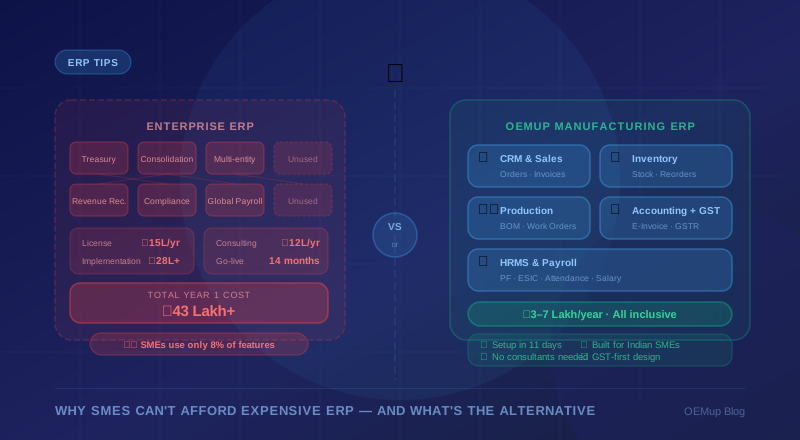
When an SME buys enterprise ERP, they typically end up using 8–12% of the system's features. The rest is irrelevant overhead — and they're paying for all of it. Worse, they need a consultant to configure even the parts they use, turning every customisation into an invoice.
Implementation alone typically costs 2–3× the license fee for Indian SMEs. Most implementations run 40% over budget and 60% over timeline. And 70% of SME ERP implementations are considered "partially failed" by the businesses that bought them.
This isn't a criticism of enterprise ERP software. Those systems do exactly what they were built to do — at scale, for large organisations. The problem is that they're being sold to businesses they were never designed for.
What SMEs Actually Need
A 40-person factory in Punjab doesn't need multi-currency treasury management or advanced revenue recognition. They need five things, done well:
That's it. Not hundreds of modules. Not a 14-month implementation. Not a consultant on retainer. Just the five things that run a factory, in one place, ready to use in days — not months.
The Cost Reality: What SMEs Are Actually Paying
Let's compare what a 30–80 person manufacturing SME typically spends on software per year — across different approaches:
❌ Enterprise ERP (Typical SME Experience)
- License/subscription: ₹8–15 lakh/yr
- AMC & support: ₹4–8 lakh/yr
- Customisation & consulting: ₹5–12 lakh/yr
- Internal IT overhead: ₹3–6 lakh/yr
- Training & re-training: ₹1–2 lakh/yr
✅ OEMup Manufacturing ERP
- All-inclusive subscription: ₹3–7 lakh/yr
- No implementation fee
- No customisation required
- No IT staff needed
- Free onboarding & training
The delta — ₹15–35 lakh per year — is money that goes directly back into the business. For most SMEs, that's the equivalent of hiring 2–3 experienced employees, upgrading a machine, or building a new production line.
Back to Ramesh
Ramesh didn't sign that ₹28 lakh proposal. He found OEMup six weeks later. Onboarding took 11 days. His purchase officer, production supervisor, and accountant were all trained and using the system by day 15. In the first month, they caught ₹4.2 lakh in dead stock they didn't know existed. By month three, they'd eliminated two production stoppages that used to happen every quarter like clockwork. By month six, his accountant filed GSTR-3B in 45 minutes instead of the usual 2-day exercise.
The difference wasn't the software features. Enterprise ERPs have more features. The difference was fit. A system built for his business, at a price that made sense for his scale, with support that spoke his language.
What Makes OEMup Different for Indian SMEs
OEMup wasn't adapted from a Western ERP template. It was designed from scratch for how Indian manufacturing businesses actually work:
- GST-first design: GSTR-1, GSTR-3B, E-Invoice, E-Way Bill, HSN codes, RCM — built in, not plugged in
- Hindi & regional language support: Your shop floor doesn't need to speak English to use OEMup
- Indian payroll complexity: PF, ESIC, LWF, contract labour, daily wages, advance management — handled natively
- WhatsApp-integrated alerts: Reorder notifications, payment reminders, and dispatch updates on the channel your team already uses
- Designed for 10–200 person factories: Not a scaled-down enterprise product, but one built specifically for SME scale and SME workflows
Day 1–3: Data migration and company setup. Day 4–7: Core modules configured (inventory, sales, production). Day 8–14: Team training. Day 15: Go live. No consultants. No extra fees.
The Real Question You Should Ask
When evaluating any ERP system, the question isn't "how many features does it have?" The question is: "Does this make my specific job easier, or harder?"
A system with 2,000 features that requires 3 clicks and a consultant to do something your factory manager needs to do 40 times a day is worse than a system with 200 features that does that one thing in a single tap.
Simplicity isn't a compromise. For SMEs, it's a competitive advantage. Every minute your team doesn't spend navigating complex software is a minute they spend making products, serving customers, and growing your business.
See If OEMup Is Right for Your Factory
Book a 30-minute demo. No sales pressure. We'll show you exactly how OEMup would work for your specific factory size, product type, and workflow.
Book a Free Demo →Conclusion: You Deserve Software Built for You
The Indian manufacturing sector has spent too long being offered second-best options — enterprise software sold at "SME-friendly" prices, or cheap tools that don't actually solve manufacturing problems.
OEMup exists because we believe Indian factory owners deserve software built specifically for them. Not a product that treats them as a smaller version of a large enterprise, but one that understands their daily reality: managing shift workers, tracking raw material by batch, handling GST with 4 different tax rates, running quality checks on the shop floor, and dealing with all of this without a dedicated IT department.
If Ramesh's story sounds familiar — if you've been quoted prices that make no sense for your business, or been using systems that solve 20% of your problems while creating 80% of your headaches — it might be time to see what purpose-built actually feels like.
We'd love to show you. Book a free 30-minute demo and see OEMup running a factory like yours.